
Key Highlights
- Overhead cranes move loads in three directions across a work area.
- Fabrication shops, warehouses and precast yards commonly use them.
- Loading trucks and moving machinery are among the most routine tasks.
- Attachments like spreader beams adapt the hoist to different loads.
- Speed and control options can be chosen to suit each type of job.
The Workhorse Above the Factory Floor
Walk into most factories, fabrication shops or warehouses and look up, and there’s a good chance you’ll spot a crane running along beams near the ceiling. It’s easy to overlook, but plenty of daily work depends on it, from shifting raw materials to sending finished products out the door.
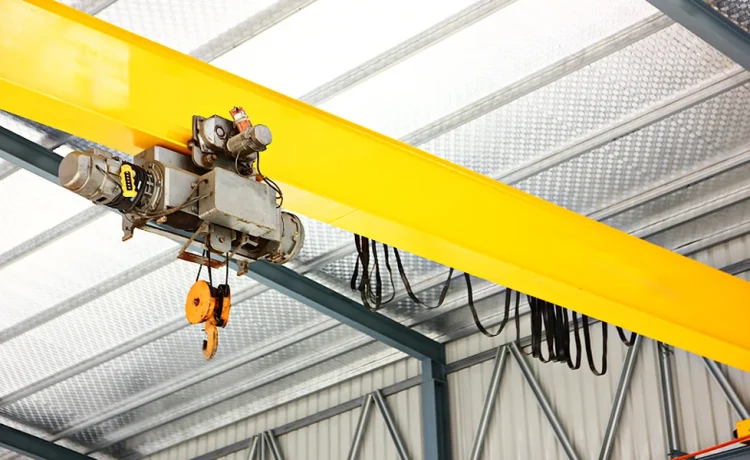
The part that’s doing the actual lifting is something called an overhead crane hoist. It raises and lowers the load. Paired with an overhead travelling crane, it can carry heavy items across a building without forklifts weaving between workers. Here’s a look at how these systems fit together and where they come in handy from one day to the next.
How the Pieces Fit Together
An overhead system is made up of a few key parts. Runway beams run along the length of the building, usually supported by columns or the structure itself. A bridge spans across those beams and travels along them, while a trolley moves sideways across the bridge, carrying the hoist with it.
Put together, this lets an overhead travelling crane reach almost any spot within its working area. The bridge handles forward and backward movement, the trolley takes care of side-to-side, and the hoist handles up and down. Since loads move above the floor, aisles stay clearer, and operators can set items down right where they’re needed.
Where They Show Up on the Job
Different industries lean on overhead lifting for different reasons. Here are a few common settings:
| Industry | How Overhead Lifting Is Used |
| Metal fabrication | Moving steel plates, beams and coils between cutting, welding and finishing stations |
| Manufacturing | Lifting heavy components onto assembly lines and setting moulds or dies into machines |
| Warehousing | Handling bulky stock that’s too heavy or awkward for forklifts to manage comfortably |
| Precast concrete | Moving finished panels from casting beds to storage or waiting transport |
| Maintenance workshops | Lifting out motors, gearboxes and other heavy parts during repairs |
In each case, the overhead crane hoist is chosen around the weights and lifting patterns typical for that work.
Everyday Jobs on the Shop Floor
Some of the most common tasks are also the most routine. Loading and unloading trucks is a big one, especially in buildings where vehicles can drive in under the crane’s coverage. Feeding raw materials into machines and lifting finished pieces back out can happen many times a shift in a busy workshop.
Turning and flipping heavy parts is another job suited to overhead lifting. Doing this with ground equipment can be awkward, whereas a careful lift, or a pair of hoists working together, can rotate a load in a controlled way. Maintenance gets simpler too, as an overhead travelling crane lets teams lift out a heavy pump or motor without bringing in outside equipment.
Matching the Hoist to the Task
Your type of work shapes which hoist suits it, so decide on these early:
- Attachments: Hooks cover most loads, but spreader beams, lifting magnets or C-hooks can make long, flat or coiled items easier to handle.
- Speed control: Dual-speed or variable-speed options let operators travel quickly and slow down for careful positioning.
- Controls: A pendant keeps the operator close to the hoist, while a radio remote lets them stand back with a clearer view of the load.
- Chain or wire rope: Chain designs often suit lighter loads and shorter lifts, while wire rope is commonly picked for heavier loads and greater heights.
These help narrow down an overhead crane hoist that fits how your team works.
Putting Overhead Lifting to Work
Overhead cranes and hoists quietly handle a lot of the heavy work in industrial buildings. By moving loads in three directions above the floor, they cover the working area without taking up space below, which keeps aisles free for people and other equipment. That’s why you’ll find them in fabrication shops, factories, warehouses and precast yards alike.
The jobs they take on range from loading trucks and feeding machines to flipping heavy parts and supporting maintenance work. Choosing a setup comes down to the loads you deal with, how often you lift and the level of control your team needs. Thinking through attachments, speed options and control styles before buying makes it easier to land on a system that fits your daily workflow.
Contact Shin Guan to discuss the lifts your team handles each day and explore crane and hoist options suited to your building.